How to Overcome Fear of Movement After an Injury
Our society is engineered for fear. That can keep your body in pain. Here's what you can do about it

In her book Bird by Bird, the writer Anne Lamott shares this experience:
When was twenty-one, I had my tonsils removed.
For the entire week afterward, swallowing hurt so much that could barely open my mouth for a straw. I had a prescription for painkillers, though, and when they ran out but the pain hadn’t, I called the nurse and said that she would really need to send another prescription over. She told me that I needed to buy some gum, of all things, and to chew it vigorously—the thought of which made me clutch at my throat.
She explained that when we have a wound in our body, the nearby muscles cramp around it to protect it from any more violation and from infection, and that I would need to use these muscles if I wanted them to relax again
Anne Lamott is a writer, and not a physical therapist, but she’s got something right about our minds and bodies.
When we get hurt, our first instinct is often to tense up and protect the injury.
This makes perfect sense from a survival standpoint. If we're bleeding or in pain, our body wants to avoid more damage. But this instinct can do more harm in the long run. When we tense up to protect an injury, we're preventing our body from full healing. The muscles and tissues around the injury tighten up.
Physical Injury, Emotional Truama, and Fear all tie together
Another Anne Lamott quote:
"Our psychic muscles can cramp around our wounds- the pain from our childhood, the losses and disappointments of adulthood, the humiliations suffered in both- to keep us from getting hurt in the same place again, to keep foreign substances out. So these wounds never have a chance to heal."
And a physical injury- pulling a muscle- breaking a bone- tearing a ligament is like that.
Whether it’s a physical injury or a traumatic childhood, we react to pain in the same way. We tense up and we overprotect. We become stuck in fear and anxiety.
It Doesn’t Help that the Modern World is Full of Fear
I don’t know what it is, but it feels like the world has become a scarier place.
Even though I know that’s rationally not true- (All sorts of studies show that things have improved A LOT), it still feels like I am always worried, anxious, and afraid about something. My body is in a perpetual fight or flight mode.
I’m also not here to point fingers at the news, or the internet, or social media. But what I do know is that it is exhausting- and it’s taking a toll on my physical health
And I'm not the only one feeling this way.
According to a recently study, anxiety and depression are on the rise. Loneliness is also at levels unseen since World War II.1 One fact that shocked me was that anger was also at an all time high. We are more hotheaded today than previous generations.
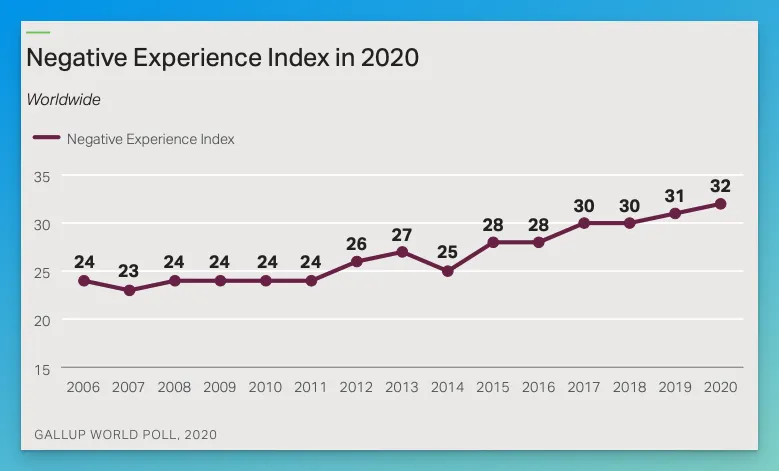
All these emtions are affecting our bodies in very real ways
Let me share a story of when my body was held back by fear
When I was a teenager, I injured my shoulder on the trampoline. I used to be a fearless daredevil. That day, I wanted to try a new trick on the trampoline. I did a risky flip, missed the landing, fell off and dislocated my shoulder.
My mind didn't help me then. (Remember- pain and fear has its place)
I saw a doctor who told me go through some physical rehab. So I did the exercises, I completed the sessions, and they sent me on my way. But I didn’t want to injure myself again.
So I started avoiding any left shoulder movements.
I always avoided moving my shoulder. I stopped doing risky sports. If I moved it a little bit I would feel afraid and worried. I even doubted if I recovered at all!
What finally got me feeling safe was talking to a coach. He saw me holding back and said "Hey, you saw your doctor. You did your exercises. You are okay! Don't let you mind hold you back."
And he's right, I did the exercises- I completed the recovery. I shouldn’t move as if I was afraid.
That did a lot to dispel the fear and uncertainty. But it was easier said than done.
My coach helped me intercept the fear, because in my own head I was playing around with the worst case scenario and it was taking me to a bad place.
You need someone’s help to work through the fear of movement
What I learned there is that on my own, I can get stuck in fear and uncertainty. I needed another person, like my coach, to reassure me that things were okay.
That's my secret to all the fear around us.
Society now always makes us feel afraid. 24/7 news. Natural disasters. Googling your symptoms. Information Overload. Constant notifications.
But my secret is this: Find ways to build more trust into your life
You don’t need more information. You don’t need to read more articles. I’m sure you’ve had more than enough of that.
That’s usually our first instinct today. When we’re afraid, we try to get more info. We believe that if we have the right knowledge, we won't be so afraid. And while getting the right knowledge helps- I think we’ve gone too far in that direction.
What makes a bigger difference is TRUST.
Here are 3 places where you can find trust to help you overcome your fear of movement
Start with a friend who listens
Even if your friend is not a doctor, and has not gone through the injury or pains that you’re experiencing- having someone that you ALREADY trust can help you feel less afraid.
We always look for quick solutions to our injury and pain, but we underestimate how healing it is to have someone that listens and empathizes. Even if they’re not injured themselves.
Find a community that has the same problem
One of the most powerful things for recovering from injury is to hear stories about people who went through the same thing.
Hearing about the different recovery experiences can help put your own journey into perspective. It can help you worry less about your own body, and whether or not you’re recovering ‘at the right pace’
More importantly, it helps emotionally to know that there are people who are also going through the same thing you are going through.
Work with a coach who has experience
Finally, it can help tremendously to have an expert take a look at what you’re going through.
A good coach is someone who listens to you, and offers their expertise while still treating you like a person. It’s not just about making your body better. It’s about giving you the emotional support to move through your injury in a full way.
Remember, recovering from injury is about improving your health and quality of life.
If the fear of movement has been holding you back, there is important mental work that you need to do moving forward.
Because the truth is, it’s impossible to completely avoid injury. No one never gets injured in their lives. There will always be some kind of risk invovled.
By building up your ‘trust muscle’ you can continue to find ways to move that are meaningful to you. Even if there is some fear every once in a while.