Issue #94 ·
How Added Sugar Ages Your Cells (and Veggies Can't Undo It)
🍭 What sugar does to your cells, are AI journals the next mental frontier, a strategy to balance your diet
Hello friends,
In Filipino culture, love speaks through the language of sweets.
During Christmas, our homes overflow with sugar-laden treats, each bite carrying memories and tradition.
But while these moments of sweetness connect us to our culture and loved ones, they also connect to our cellular health in ways science is just beginning to understand.
This isn't about giving up our traditions or feeling guilty—it's about being mindful.
Think of it as adding wisdom to our celebrations, not subtracting joy.
This week in building health 👇
The Sweet Science of Cellular Aging
Sugar's impact on your body goes deeper than you might think.
Recent UCSF research reveals how added sugar accelerates aging at the cellular level—not just surface effects, but fundamental changes to your genetic expression.
These changes, known as "epigenetic modifications," alter how your genes function. And here's the crucial part: these effects happen regardless of how healthy the rest of your diet might be.
Loading up on superfoods like kale and salmon is fantastic for your health—but it can't undo sugar's impact on your cells. Each gram of added sugar leaves its mark, potentially accelerating the aging process.
The Balance Myth
"I'll just have extra vegetables to balance out the dessert."
Sound familiar?
This common thinking trap comes from misunderstanding what a "balanced diet" really means.
The truth is stark: your body doesn't work like a mathematical equation. You can't cancel out sugar's effects by adding more healthy foods. Those cellular changes we talked about? They happen regardless of how many salads you eat afterward.
A truly balanced diet isn't about compensation—it's about consistent, mindful choices. Your cells don't negotiate, and neither should you.
Smart Strategies for Sweet Moments
The key to enjoying holiday treats isn't willpower—it's strategy. Here's how to savor the sweetness without compromise:
Master the Art of the Taste. Start with a small portion—often the first three bites bring the most pleasure anyway.
Time it Right. Fill up on protein-rich foods first. A satisfied appetite makes sweet cravings less intense.
Choose Your Treats Wisely. Opt for quality over quantity. Dark chocolate with 70%+ cocoa or naturally sweet fruits can satisfy cravings with less impact.
My favorite health things for the week
// one
How Stress and Cholesterol are Linked
14 minutes | Yvette Brazier
In my practice, clients often resist the simple truth: their stress levels may impact their cholesterol more than their diet.
When I mention stress management, they expect to discuss meditation apps or breathing exercises. What they don't expect is the science: chronic stress triggers hormonal cascades that directly elevate "bad" LDL cholesterol and triglycerides—sometimes negating the benefits of an otherwise perfect diet.
It's the hardest sell in health coaching, yet potentially the most important. While clients focus on counting fat grams, their unmanaged stress quietly undermines their cardiovascular health.
// two
What I learned from sharing my private self with an AI journal
23 minutes | Angela Chen
For those of us who struggle to maintain a traditional journaling practice, AI-powered journals offer an intriguing alternative.
These tools analyze written entries to reveal patterns in thoughts and emotions—something like a Fitbit for our inner lives.
While I'm skeptical of tech solutions for every human challenge, and privacy concerns can't be ignored, there's something compelling about having a tool that might help decode our mental patterns.
At minimum, it's a fascinating glimpse into how technology might augment one of humanity's oldest forms of self-reflection.→ Read More About it Here
// three
What is The Composite Dietary Antioxidant Index?
12 minutes
Researchers use the Composite Dietary Antioxidant Index (CDAI) to evaluate the overall antioxidant capacity of an individual's diet.
What I find interesting about it is how it emphasizes variety so that you get enough nutrients.
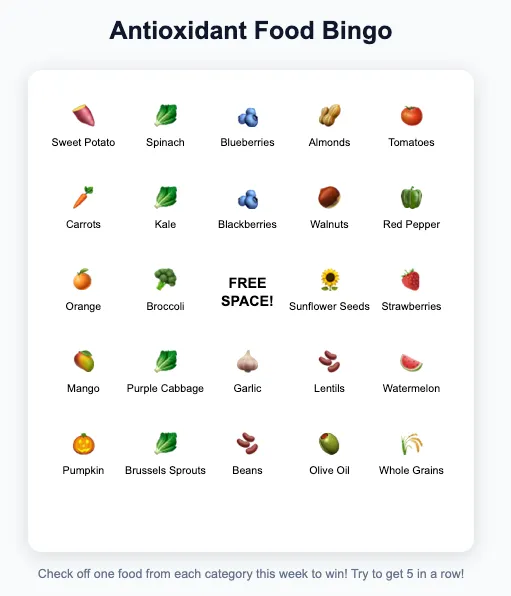
So here’s a quick practical application: Think of it like food bingo!
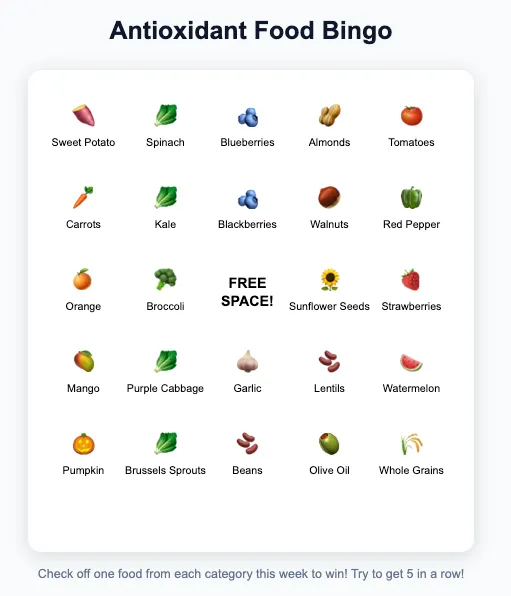
The goal would be to eat everything on this card every calendar week. When something is crossed out, you can’t go back to it again!
Until next time
Have a Healthy Weekend